



The Originality Premium: How Small Budgets Beat Big Ones
Kim Notz
20. August 2026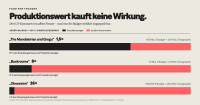
The Most Expensive Way to Avoid Risk
In early June, three films opened in US cinemas within days of each other. Their numbers reveal more about creative work than any industry study could.
As Oliver McAteer noted in his Marketing Beast newsletter, The Mandalorian and Grogu cost more than $165 million to produce, making it the most expensive Star Wars production since Disney acquired the franchise. By its second weekend, the film was barely holding on to a place in the top three at the box office, marking one of the weakest receptions for a Star Wars film in years.
Two other films released in the same window tell the opposite story. Obsession, a psychological horror film about a man who uses voodoo to make his crush fall in love with him, was produced for $750,000 and went on to gross $26.4 million. Backrooms grew out of a creepypasta, an anonymous internet legend that has circulated through the darker corners of the web for years. Production budget: around $10 million. Box office: $81 million.
The economics are hard to ignore. A $750,000 production generates 35 times its budget, a $10 million production returns eight times its investment, while a $165 million production barely makes the top three. Production value does not buy impact. The idea does, regardless of the budget behind it.
What Kane Parsons Is Defending
Kane Parsons, the 20-year-old director of Backrooms, was asked on CBS Mornings whether he would ever use AI in his work.
His response: “Absolutely not. Art is a way of processing life. I see no value in outsourcing any part of it.”
What Parsons is defending is less about technology than about the willingness to take a risk. Backrooms originated in a myth, without a studio brief, without test audiences, without an approval committee. There was nobody there to assess whether the idea would “work.” That is precisely what makes its origins credible.
Anyone telling a story that grows out of a personal obsession is taking a risk: that it might be too strange, too personal, too inaccessible. That risk is exactly why it works when it does.
AI can generate images that look like fear. But it cannot risk anything. At its core, what a model produces is already hedged, because it is derived from patterns across millions of existing examples. That built-in safety is the opposite of what makes a story memorable: the sense that someone has revealed something of themselves, knowing that they might fail.
Cannes: The Originality Premium
At the Cannes Lions Festival two weeks later, the same phenomenon could be observed from a different angle. Oliver McAteer, who attended the festival, describes two developments that are closely connected.
AI companies had taken over virtually every available corner of the festival. Quiet restaurants that had once been places to retreat for a meeting were suddenly occupied by companies no one had heard of before.
And yet the conversation around AI remained remarkably unchanged. Everywhere, the message was that the industry had moved from hype to adoption. But no one could point to a single end-to-end case in which AI had identified a business problem, uncovered the relevant cultural insight and developed an original idea that ultimately delivered a measurable result.
That, McAteer argues, is precisely why marketing leaders on the Croisette were looking for something else: human thinking and genuine collaboration rather than yet another platform.
There is currently a clear premium on originality. The world has become louder than ever, making it increasingly difficult for brands to be heard at all. McAteer calls this the “originality premium.”
Vendors are, of course, trying to package that very originality at the festival and sell it as a product. But the more astute marketers understand that genuine originality cannot be commoditised. Platforms, products and tools remain infrastructure. What gets built on that infrastructure still requires a human being with an idea of their own.
The more infrastructure there is, the scarcer everything it cannot provide becomes.
What This Means in Practice
This is more than an interesting observation from the box office and the Croisette. Investing in safety, through bigger budgets, more polish, more rounds of testing and more AI-enabled validation, does not automatically buy impact. Often, it simply buys a more expensive form of mediocrity.
The question is not whether to use AI. The question is where in the process there is still room for that one risky idea, originating from a real person with a genuine obsession.
That is rarely decided in a major strategy document. More often, it comes down to three small moments: the brief, which either leaves room for the unconventional or rules it out from the start; the approval meeting, where someone has to defend the idea the first time it meets resistance; and the mandate someone in the room needs in order to push an idea through despite a general sense of discomfort.
On this point, Cannes Lions and the box office tell the same story: the winners are the ones who allowed the idea to remain risky, regardless of the size of the budget.